Let It Rain
(Clapton/Bramlett)
From the Eric Clapton album Eric Clapton
Like
“Coming Home” from Delaney & Bonnie and
Friends On Tour with Eric Clapton,
“Let It Rain” is credited to Eric Clapton and Bonnie Bramlett, but it was
almost certainly a collaboration between Clapton and Delaney. Delaney was at
the top of his game in the late 1960s and early 1970s, and as Bobby Whitlock
said, “everyone wanted a piece of what Delaney had.” And it seems Delaney was
willing to spread it around, giving away songwriting credits, among other
things.
“Let It
Rain” is the last song on Clapton’s first solo album. Carl Radle plays bass on
every track on the album, and turns in a masterful effort on this classic. For
the verses and choruses, he has a pretty concrete skeleton of a line that he
sticks to, but he continually improvises around it. Radle’s concept for the
line is to hit the root of the chord then walk up or down, diatonically or
chromatically, to the root of the next chord. (“Diatonic” means notes within
the key. “Chromatic,” generally, means notes outside of the key. In this case,
a chromatic walk-up or –down means moving in half-steps regardless of the key.)
Looking at the first few measures of the first verse, we see Radle’s
path through the chord progression. He plays the root (D) on the downbeat of
the first measure. He leaps briefly to the 5th of the chord (A) on
the “and” of beat 2, then back to the root. At the end of the first measure he
begins a diatonic walk-down (D-C-B) to the root of the next chord (A). In
measure 2, he takes a similar approach. He plays the root of the chord (A) on
the downbeat, moves to the 5th (E) on beat 3, then moves back to the
root to begin a chromatic walk-up (A-A#-B) to the root of the next chord (C).
In the third measure, he plays the root (C) on the downbeat, then walks down
diatonically to the next root (G) on beat 3, then walks up chromatically (C-C#)
to arrive back at the root of the next chord (D).

Radle
approaches much of the song this way. Even when the chord progression changes
for the guitar solo, he keeps this idea of approaching the root of each chord
via a chromatic walk-up or walk-down.
In
playing a melodic bass line—rather than just playing chord roots, or a
repetitive riff/pattern that gets transposed up and down the neck—we
essentially have two options: play a line based on the scale (diatonic or
chromatic) or play a line based on arpeggios (root, 3rd, 5th,
7th, etc.). Often a line will be some combination of the two. Much
of the bass line for this song utilizes the scale. Radle doesn’t explore
arpeggios much until the outro (mm. 89 to the end). At this point, the line
becomes almost exclusively arpeggio patterns. Or, more precisely, it makes use
of major pentatonic scales, which are root-2nd-3rd-5th-6th.
You can think of the pentatonic scale as a major scale without the 4th
and 7th, or as a major arpeggio plus a 2nd and 6th
above the root. In this way, a pentatonic scale is somewhere in between a
diatonic scale and an arpeggio. In the example below, I have labeled each note
of the scale, with the 2nd and
6th in parentheses to show they are members of the pentatonic
scale, but outside of the arpeggio.
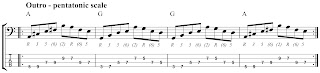
A full transcription is below.


