Showing posts with label Delaney & Bonnie. Show all posts

Tuesday, September 8, 2020

Soldiers of the Cross

 "Soldiers of the Cross"
(Traditional, arr. by Bramlett)
From the Delaney & Bonnie album Accept No Substitute

“Soldiers of the Cross” is a traditional gospel tune arranged by Delaney Bramlett for the first Delaney & Bonnie album, Accept No Substitute. It has a “two” feel, typical of a lot of gospel music. The basic groove is just a root-5th pattern—sort of an embellished country bass line, but with a lot of bounce. During the fourth and seventh verses, Radle goes to double time. (Drummer Jimmy Karstein stays in double time from the fourth verse to the end of the song.) 

Delaney & Bonnie Carl Radle bass line transcription

In m. 95, Radle plays the open E string, which is most likely an accident. He probably meant to play A, as he had in the preceding and succeeding measures. It isn’t the worst note he could have played, but it doesn’t make much sense in the context of the rest of the line. This is one of several “wrong” notes that appear in these transcriptions. In each case, it is clear that Radle made a mistake, but because the feel remained strong and the overall performance was energetic, the wrong note was not deemed a substantial problem. In fact, I did not notice most of these mistakes until it came time to actually transcribe the bass lines, even if I had listened to the song a hundred times before. It is pretty powerful evidence that having a good feel and locking in with the rest of the band is significantly more important than the actual notes you play.


Sunday, December 29, 2019

Let It Rain

Let It Rain
(Clapton/Bramlett)
From the Eric Clapton album Eric Clapton

Like “Coming Home” from Delaney & Bonnie and Friends On Tour with Eric Clapton,
“Let It Rain” is credited to Eric Clapton and Bonnie Bramlett, but it was almost certainly a collaboration between Clapton and Delaney. Delaney was at the top of his game in the late 1960s and early 1970s, and as Bobby Whitlock said, “everyone wanted a piece of what Delaney had.” And it seems Delaney was willing to spread it around, giving away songwriting credits, among other things.

“Let It Rain” is the last song on Clapton’s first solo album. Carl Radle plays bass on every track on the album, and turns in a masterful effort on this classic. For the verses and choruses, he has a pretty concrete skeleton of a line that he sticks to, but he continually improvises around it. Radle’s concept for the line is to hit the root of the chord then walk up or down, diatonically or chromatically, to the root of the next chord. (“Diatonic” means notes within the key. “Chromatic,” generally, means notes outside of the key. In this case, a chromatic walk-up or –down means moving in half-steps regardless of the key.)

Looking at the first few measures of the first verse, we see Radle’s path through the chord progression. He plays the root (D) on the downbeat of the first measure. He leaps briefly to the 5th of the chord (A) on the “and” of beat 2, then back to the root. At the end of the first measure he begins a diatonic walk-down (D-C-B) to the root of the next chord (A). In measure 2, he takes a similar approach. He plays the root of the chord (A) on the downbeat, moves to the 5th (E) on beat 3, then moves back to the root to begin a chromatic walk-up (A-A#-B) to the root of the next chord (C). In the third measure, he plays the root (C) on the downbeat, then walks down diatonically to the next root (G) on beat 3, then walks up chromatically (C-C#) to arrive back at the root of the next chord (D).


Carl Radle Eric Clapton Let It Rain bass transcription


Radle approaches much of the song this way. Even when the chord progression changes for the guitar solo, he keeps this idea of approaching the root of each chord via a chromatic walk-up or walk-down.

In playing a melodic bass line—rather than just playing chord roots, or a repetitive riff/pattern that gets transposed up and down the neck—we essentially have two options: play a line based on the scale (diatonic or chromatic) or play a line based on arpeggios (root, 3rd, 5th, 7th, etc.). Often a line will be some combination of the two. Much of the bass line for this song utilizes the scale. Radle doesn’t explore arpeggios much until the outro (mm. 89 to the end). At this point, the line becomes almost exclusively arpeggio patterns. Or, more precisely, it makes use of major pentatonic scales, which are root-2nd-3rd-5th-6th. You can think of the pentatonic scale as a major scale without the 4th and 7th, or as a major arpeggio plus a 2nd and 6th above the root. In this way, a pentatonic scale is somewhere in between a diatonic scale and an arpeggio. In the example below, I have labeled each note of the scale, with the 2nd and  6th in parentheses to show they are members of the pentatonic scale, but outside of the arpeggio.
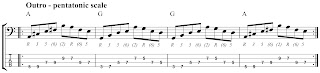
Carl Radle Eric Clapton Let It Rain bass transcription

A full transcription is below.

Carl Radle Eric Clapton Let It Rain bass transcription

Carl Radle Eric Clapton Let It Rain bass transcription

Carl Radle Eric Clapton Let It Rain bass transcription

Carl Radle Eric Clapton Let It Rain bass transcription

Carl Radle Eric Clapton Let It Rain bass transcription


Friday, November 22, 2019

Don't Know Why

Don't Know Why
(Bramlett/Clapton)
From the Eric Clapton album Eric Clapton

“Don’t Know Why” is another song that came from the fruitful months of collaboration between Eric Clapton and Delaney Bramlett, from the fall of 1969 through the spring of 1970. Bramlett was a huge influence on Clapton, and helped him gain confidence in his singing and songwriting. This is mostly a Delaney Bramlett song. In a 1970 interview with Melody Maker Magazine, Clapton said, “it was an idea Delaney had when he came to England, and we finished it while he was staying at my house.” It’s essentially a gospel ballad, the type of song Bramlett could write in his sleep.

Radle’s bass line leaves plenty of space, but still moves around enough to keep things interesting. Had this song ended up on a Clapton album in the later ‘70s, Radle likely would have played a simpler, stricter line, probably closer to the style of “Wonderful Tonight.”

The verses and choruses feature very similar grooves. Radle uses the pattern below often, with only occasional variation of it.

Carl Radle bass Clapton Delaney Bramlett

The song builds in intensity to the final chorus and outro, which is just a two-measure tag repeated multiple times before fading. This outro is one of the funnest parts of the song to play. On the C and Bb chords, Radle plays the roots embellished with upper neighbor tones. Then on the F chord, he ascends through two octaves of an F pentatonic scale.


Carl Radle bass Clapton Delaney Bramlett

A full transcription is below.

Carl Radle bass Clapton Delaney Bramlett

Carl Radle bass Clapton Delaney Bramlett

Saturday, November 16, 2019

Where There's a Will, There's a Way

Where There's a Will, There's a Way
(Bramlett/Whitlock)
From the Delaney & Bonnie album On Tour with Eric Clapton


This transcription of “Where There’s a Will, There’s a Way” is taken from Delaney & Bonnie's On Tour With Eric Clapton. (Also see my transcription of "Coming Home" from that album.) On the verses, Radle sticks with a one-measure groove in constant eighth notes. When the chord changes from D to G, he keeps the same pattern, but transposes it up a perfect fourth. He maintains the straight eighth notes in the chorus, but notice how in the second half of the chorus, the pattern is cut in half, from four beats to two beats. This helps build excitement and makes the chorus feel like it is really moving forward.

Carl Radle Delaney and Bonnie Bobby Whitlock Eric Clapton bass

In the bridge, Radle simplifies his line melodically, playing mainly roots, but incorporates a little more syncopation. This is a really effective method of building tension, which is the primary purpose of the bridge in this song--to provide relief from repetitions of the verse and chorus, but also to build tension that can be released by a return to the verse. Playing a more active bass line might have made the bridge feel frantic. Instead, Radle increases the energy of the song with less melodic movement and slight syncopation.


A full transcription is below.


Carl Radle Delaney and Bonnie Bobby Whitlock Eric Clapton bass


Carl Radle Delaney and Bonnie Bobby Whitlock Eric Clapton bass


Carl Radle Delaney and Bonnie Bobby Whitlock Eric Clapton bass


Carl Radle Delaney and Bonnie Bobby Whitlock Eric Clapton bass


Carl Radle Delaney and Bonnie Bobby Whitlock Eric Clapton bass

Tuesday, October 29, 2019

After Midnight

After Midnight
(J. J. Cale)
From the Eric Clapton album Eric Clapton


“After Midnight” was written by J. J. Cale and recorded by Clapton for his first solo album, Eric Clapton, produced by Delaney Bramlett. (Cale also recorded the song for his album Naturally, which featured Carl Radle on bass. See previous posts.) Bramlett initially wanted to call this album “Eric Clapton Sings” because of the emphasis on Clapton’s singing and songwriting rather than his guitar playing. At the time, however, Clapton was not a very experienced singer. On most of the tracks, Bramlett recorded a guide vocal and Clapton later overdubbed his own vocal, trying to match Bramlett’s phrasing and inflection. Because of this, and the fact that most of the musicians were currently members of Delaney & Bonnie and Friends, the album sounds less like a Clapton solo album, and more like a Delaney & Bonnie project.

When Clapton needed another song for his debut album, Radle played him a tape of some of Cale's demos. Clapton was immediately smitten, and chose to record "After Midnight," which would become one of the signature songs from this album. Clapton would later record Cale's "Cocaine" for his 1977 Slowhand album. Much of Clapton's post-Dominos music is seriously indebted to Cale's laid back approach. 

Radle’s bass line on “After Midnight” is a bouncy gospel groove. It is essentially a country bass line with embellishments. The ghost notes give it a percussive feel and infuse it with a sort of instant kinetic energy. The bass line would work without them, but the ghost notes are what makes it groove. Below is a sample measure from the verse, followed by the same line with the ghost notes removed. Play them both and notice how crucial the ghost notes are. The groove is in the ghost notes.


Carl Radle JJ Cale Eric Clapton After Midnight bass

A full transcription is below.

Carl Radle JJ Cale Eric Clapton After Midnight bass

Carl Radle JJ Cale Eric Clapton After Midnight bass

Carl Radle JJ Cale Eric Clapton After Midnight bass


x

Monday, September 23, 2019

Coming Home

Coming Home
(Bonnie Bramlett and Eric Clapton)
From the Delaney & Bonnie album On Tour with Eric Clapton

Released as a single in Europe, "Coming Home" is the signature song from the Delaney & Bonnie album On Tour With Eric Clapton. The songwriting credit goes to Bonnie Bramlett and Eric Clapton, but it was almost certainly a collaboration between Clapton and Delaney. 

The song is built around a two-measure guitar riff in A. Radle plays a complementary bass riff that locks in well with the guitars, becoming a sort of secondary hook. Being that there were four guitars, keyboards, and a horn section all playing in roughly the same register, Radle's bass cuts through very well as he was not competing with anything else in the lower register. 


Carl Radle bass Delaney Bonnie

During the verses, Radle shifts to a line with a little less movement, but a bit more syncopation, which keeps propelling the line forward to the next downbeat. Though he adds slight embellishments to the line fairly regularly, most of the song can be played with just the two-measure riff and the two-measure verse groove. 


Carl Radle bass Delaney Bonnie

There is also a simple bridge in E that occurs only once. This is the only harmonic change in the entire song. The rest of it is just riffs in A major.


Carl Radle bass Delaney Bonnie


Dirty Old Man

Dirty Old Man
(Delaney Bramlett and Mac Davis)
From the Delaney & Bonnie album Accept No Substitute

Unlike Home, 1969's Accept No Substitute (also known as The Original Delaney & Bonnie) featured the same backing band on the entire album. The core of this band, which included Radle, Bobby Whitlock, Rita Coolidge, and Bobby Keys, would remain with Delaney & Bonnie for the rest of the year, touring England and the European continent in late 1969 and early 1970. 

"Dirty Old Man" is kind of a modified twelve-bar blues with a bridge. (The first two verses are actually 13 bars each.) Radle's bass line is build largely on arpeggios. The root-3rd-5th-6th pattern is typical of a lot of blues songs, but this one is infused with an R&B groove. Instead of being a shuffle, which implies a triplet subdivision of each beat, the groove here has a sixteenth note subdivision. Radle plays essentially the same line for verses 1 and 2.


Carl Radle bass Delaney Bonnie

Radle uses lots of ghost notes to propel the song forward. Syncopations occur almost exclusively on beats 3 and 4. The following rhythmic pattern appears frequently in his line:


Carl Radle bass Delaney Bonnie

This is a common figure in R&B and soul music. In fact, it is not unlike the syncopation Radle uses in the choruses of "Piece of My Heart."

The bridge serves as a bit of relief from the repetition of the verses, but also allows the band to modulate up a half-step to C. Radle keeps the same type of 16th note syncopation, but his line sounds much more improvisatory than it did in the verses. 

Carl Radle bass Delaney Bonnie


After the bridge, the band goes through a verse in C Major. Radle keeps essentially the same groove.


Carl Radle bass Delaney Bonnie

The outro is just a vamp from C to F. Radle continues his verse groove, but with added embellishments, particularly on the F chords.


Carl Radle bass Delaney Bonnie

Piece of My Heart

Piece of My Heart
(Composed by Jerry Ragovoy and Bert Berns)
From the Delaney & Bonnie album Home


This track was featured on Delaney & Bonnie’s album Home, released on Stax Records in 1969. The rhythm section on much of the record was the Stax house band, Booker T. and the MGs. “Piece of My Heart” is one of two songs that utilize Carl Radle, Leon Russell, and Jimmy Karstein instead of the MGs. (Radle also plays on two of the bonus tracks included on the 2006 CD release.)

During the verses, Radle plays a very simple dotted quarter-eighth note pattern, typical of medium tempo songs. There is a clear hierarchy in the verses of this song. Bonnie’s vocal is the primary focus. Delaney’s guitar fills are secondary. Radle’s role is to be supportive and stay out of the way. This bass line provides a lot of space for Bonnie to be expressive with her vocal, and it does not interfere with Delaney’s guitar fills.


Carl Radle bass Delaney Bonnie

Radle gets to step out a little more during the choruses. The energy of the whole band ramps up, and Radle responds by moving from the long-note groove of the verse to a primarily sixteenth note line in the chorus. He also provides a nice counterpoint to the vocal. As Bonnie’s melody descends, Radle’s bass line ascends Eb-G-Ab-A-Bb (see mm. 14-15). He then punctuates the phrase with the syncopated riff on beats 3 and 4 of the Bb chord.

Carl Radle bass Delaney Bonnie

Radle provides almost no variation in the groove from verse to verse. He experiments a bit more in the chorus, particularly as the song builds towards the end. Most of the embellishments occur over the Bb chord as the band repeats the chorus three times before ending. So, even as the song builds to a frenzy, Radle is carefully choosing his spots to bring a bit of flash.